Thursday, January 21, 2010

Chile: Salar de Atacama & Bipolar Disorder.

Santiago, Chile was the starting point of our recent cruise round Cape Horn. We had a wonderful guide who took us from Santiago city to the Valparaiso port, where we boarded our cruise liner. She was infectiously enthusiastic. She told us that apart from copper, agricultural products and wine, Chile produced something that was very important for her brother.  He suffers from Trastorno Afectivo Bipolar (Bipolar Disorder) and Chile is the world’s largest producer of lithium.


  Wikimedia Commons SalarDeatacamaFromChaxa.jpg
Some of the world’s most important deserts are around the Tropics of Cancer and Capricorn and here in Chile the desert called Salar de Atacama is no exception. 
Our guide told us that as the snow melts in the Andes the water went underground and dissolves the lithium salt to form lithium brine. It is pumped to the surface where the sun did the rest of the work in evaporating the water content. Lithium could then be extracted from the salt. According to Forbes, the solar energy keeps lithium extraction costs to an estimated $1,260 per ton of lithium carbonate. It sells that ton for up to $12,000.


NASA’s Earth Observatory
From the NASA website:

The Salar de Atacama in Chile is an enclosed basin with no drainage outlets. (Salar is Spanish for “salt flat.”) The salar is located in the southern half of the Atacama Desert; with no historical or current records of rainfall in some parts of this desert, it is considered to be one of the driest places on Earth.

The brines are pumped to the surface through a network of wells and into large, shallow evaporation ponds; three such evaporation facilities are visible in the center of the image. Color variations in the ponds are due to varying amounts of salts relative to water. The dry and windy climate enhances evaporation of the water, leaving concentrated salts behind for extraction of the lithium.


There is increased industrial use of lithium.  Major car manufacturers are switching to lithium batteries which are much lighter than conventional ones. It could mean 250 miles to the gallon for hybrid cars and even better for solar panel ones.
We are already using lithium batteries in a number of electronic equipments such as BlackBerrys, iPods, computers and digital cameras.


Amazing what a desert can yield!

Please spare some lithium for Bipolar Disorder though.


Lithium for Manic-Depressive Disorder (Bipolar Disorder):


Cade, John Frederick Joseph (1912 - 1980)
Taking lithium himself with no ill effect, John Cade then used it to treat ten patients with chronic or recurrent mania, on whom he found it to have a pronounced calming effect. Cade's remarkably successful results were detailed in his paper, 'Lithium salts in the treatment of psychotic excitement', published in the Medical Journal of Australia (1949). He subsequently found that lithium was also of some value in assisting depressives. His discovery of the efficacy of a cheap, naturally occurring and widely available element in dealing with manic-depressive disorders provided an alternative to the existing therapies of shock treatment or prolonged hospitalization.

In 1985 the American National Institute of Mental Health estimated that Cade's discovery of the efficacy of lithium in the treatment of manic depression had saved the world at least $US 17.5 billion in medical costs.

And many lives too!


Sunday, January 3, 2010

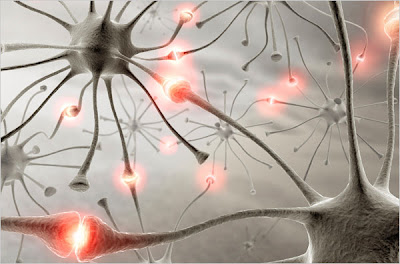
Good News For 2010: The Old Brain Can Learn!

Can an old brain learn, and then remember what it learns?

Grey Matter New York Times/Illustration from istockphoto.com


The New York Times  gave some encouraging news for the New Year.


As it happens, yes. While it’s tempting to focus on the flaws in older brains, that inducement overlooks how capable they’ve become. Over the past several years, scientists have looked deeper into how brains age and confirmed that they continue to develop through and beyond middle age.
Many long held views, including the one that 40 percent of brain cells are lost, have been overturned.


Remember the London Taxi Drivers?
Recently, researchers have found even more positive news. The brain, as it traverses middle age, gets better at recognizing the central idea, the big picture. If kept in good shape, the brain can continue to build pathways that help its owner recognize patterns and, as a consequence, see significance and even solutions much faster than a young person can.


Perhaps that is why some of us blog: The Jobbing Doctor, Dr Grumble.
The trick is finding ways to keep brain connections in good condition and to grow more of them.
The more we blog, the better?
“The brain is plastic and continues to change, not in getting bigger but allowing for greater complexity and deeper understanding,” says Kathleen Taylor, a professor at St. Mary’s College of California, who has studied ways to teach adults effectively. “As adults we may not always learn quite as fast, but we are set up for this next developmental step.”
Educators say that, for adults, one way to nudge neurons in the right direction is to challenge the very assumptions they have worked so hard to accumulate while young. With a brain already full of well-connected pathways, adult learners should “jiggle their synapses a bit” by confronting thoughts that are contrary to their own, says Dr. Taylor, who is 66.
 “There’s a place for information,” Dr. Taylor says. “We need to know stuff. But we need to move beyond that and challenge our perception of the world. If you always hang around with those you agree with and read things that agree with what you already know, you’re not going to wrestle with your established brain connections.”
Such stretching is exactly what scientists say best keeps a brain in tune: get out of the comfort zone to push and nourish your brain. Do anything from learning a foreign language to taking a different route to work.
Better get out my Spanish discs again as we get ready for South America!
“As adults we have these well-trodden paths in our synapses,” Dr. Taylor says. “We have to crack the cognitive egg and scramble it up. And if you learn something this way, when you think of it again you’ll have an overlay of complexity you didn’t have before — and help your brain keep developing as well.” New York Times  :BARBARA STRAUCH

Monday, December 21, 2009

Copenhagen: Snow & Warming

Blizzard Dumps Snow on Copenhagen as Leaders Battle Warming
Last Updated: December 17, 2009 06:52 EST 
Dec. 17 (Bloomberg) -- World leaders flying into Copenhagen today to discuss a solution to global warming will first face freezing weather as a blizzard dumped 10 centimeters (4 inches) of snow on the Danish capital overnight.
“Temperatures will stay low at least the next three days,” Henning Gisseloe, an official at Denmark’s Meteorological Institute, said today by telephone, forecasting more snow in coming days. “There’s a good chance of a white Christmas.”
Delegates from 193 countries have been in Copenhagen since Dec. 7 to discuss how to fund global greenhouse gas emission cuts. U.S. President Barack Obama will arrive before the summit is scheduled to end tomorrow.
Denmark has a maritime climate and milder winters than its Scandinavian neighbors. It hasn’t had a white Christmas for 14 years, under the DMI’s definition, and only had seven last century. Temperatures today fell as low as minus 4 Celsius (25 Fahrenheit).
DMI defines a white Christmas as 90 percent of the
country being covered by at least 2 centimeters of snow on the afternoon of Dec. 24.

Copenhagen climate summit: 1,200 limos, 140 private planes and caviar wedges
Copenhagen is preparing for the climate change summit that will produce as much carbon dioxide as a town the size of Middlesbrough.
As well 15,000 delegates and officials, 5,000 journalists and 98 world leaders, the Danish capital will be blessed by the presence of Leonardo DiCaprio, Daryl Hannah, Helena Christensen, Archbishop Desmond Tutu and Prince Charles. A Republican US senator, Jim Inhofe, is jetting in at the head of an anti-climate-change "Truth Squad." The top hotels – all fully booked at £650 a night – are readying their Climate Convention menus of (no doubt sustainable) scallops, foie gras and sculpted caviar wedges.


The answer may always have been there:


In the meantime The Guardian had a collection of slides of snow scenes as far south as Brighton. Here are a few selections.


The Jill windmill at Clayton, near Brighton, west Sussex
Photograph: Luke MacGregor/Reuters
 Snow-covered beach in Brighton
Photograph: John Stillwell/PA

A deer walks through the snow in Knole park, Sevenoaks, Kent
Photograph: Carl De Souza/AFP/Getty Images


Snow blankets the lawn in front of the White House
Picture: AFP / GETTY


Washington DC: The US Capitol is nearly obscured during a heavy snow fall
Photograph: Brendan Hoffman/EPA


The base of the Eiffel Tower is barely visible as a couple walk in a heavy snowfall
Picture: EPA

Picture: AFP/GETTY

People wait to enter the Louvre museum as snow falls
Picture: AP
Venice: Snow-covered gondolas moored in Venice's lagoon
Photograph: Luigi Costantini/AP


Sunday, December 20, 2009

Did You Catch These: Anorexia Nervosa


One hath no better thing under the sun than to eat, and to drink, and to be merry ...
- Ecclesiastes 8.15


I could well remember one Christmas morning doing a special round as one Anorexia Nervosa patient could not be discharged. My wife and children waited in the car as we had to drive to London to spend Christmas at our good friend’s place afterwards.

It may be the right time to look back on my posts on Anorexia Nervosa:

A Brief History of Time: Anorexia Nervosa


Tate
Crisp (1967 - 1980):
  • Anorexia nervosa serves to protect the individual from adolescent turmoil.
  • Anorexia nervosa reflects a phobic avoidance of sexual maturation.
  • Unsettling effects of sexual maturation at puberty may drive the female adolescent to a pursuit of thinness leading to greater acceptance, self-control and self-esteem.
  • Anorexia nervosa tends to appear in families with buried, but unresolved, parental conflicts.
Palazzoli (1978) on women’s role (not just Anorexia Nervosa)
  • Women are expected to be beautiful, smart and well-groomed.
  • They are expected to have a career and yet be romantic, tender and sweet.
  • They are expected to devote a great deal of time to their personal appearance even while competing in business and professions.
  • In marriage, they are expected to play the part of the ideal wife cum mistress cum mother.
  • They are expected to put away her hard-earned diplomas to wash nappies and perform other menial chores.
  • The modern woman is therefore exposed to a terrible social ordeal, and the conflicting demands and dual image of the female body as sex symbol and as commodity.
  • An adolescent girl may develop feelings of insecurity and alienation toward her changing body.


Minuchin’s concept of the psychosomatic family (enmeshment, rigidity, over-protectiveness, and lack of conflict resolution) was both insightful and ground breaking at the time. However, it seems to be no longer fashionable or politically correct in the modern day no-blame culture. I do not have any argument with the no-blame approach, but it would not hurt psychiatrists to understand cases from Minuchin’s point of view without making a song and dance about it.
Sometimes modern parents give their children too much right and freedom for self determination.
In the chapter “SARS and Knowledge” of my book, I compared the freedom to starve oneself to that of not wearing a mask during the SARS outbreak in the endemic zones:
“…… If a child can be made to wear an uncomfortable mask, why can parents not make a child eat?...”
In matters concerning life or death, shouldn’t zero tolerance really be a no-brainer?

No doubt the promotion of zero size models by the fashion industry has managed to exert undue influence on some gullible teenagers and created a “cult” following. Have you not noticed how frightened some of the anorectics are of even the slightest touch of fat? How they panic when banned from exercising! There always seems to be a little voice in their head asking them to disobey their parents, nurses, psychiatrists and anyone who tells them that their belief is wrong. Like any cult rescue, someone needs to take over and the one taking over will take over the wrath of the new Anorexia god.
“It is not me who wants to eat, it is them.”
All those trying to help are on the “other side”
Yet, given time, there will be recovery for cult victims, at least for some.


Anorexia Nervosa: What If!

What if in DSM V (the next edition of DSM), Anorexia Nervosa was voted out by the psychiatrists as a mental condition? (As they did with Homosexuality in 1973.) What if the European Court of Human Rights deemed it against human rights to forcibly treat Anorexia Nervosa? (Remember Ghandi?)
My speculations are that under these circumstances:
1:A third of the parents would take over and make sure that their bright young offspring eat properly and stop blaming adolescent units for failing them.
2:A third would have rich enough parents who would pay for their expensive treatment in health farms.
3:Some would be snapped up by modelling agencies as the world is hungry for skinny models.
The reality is that the availability of force feeding as a last resort often leads to complacency in the Psychiatric Team. Creativity is key to the resolution of many Child Psychiatric problems and the fact that Anorexia Nervosa patients can change dramatically in a split second is testament to the need for such an approach. (The Chapter “Seven Minute Cure” in The Cockroach Catcher describes such a case.) I am not advocating the declassification of Anorexia Nervosa, but would just like to encourage those of us dealing with these cases to try to understand the underlying dynamics and be innovative in their management. It could be a worthwhile experience.

Anorexia Nervosa: Bach

In The Cockroach Catcher Dr Zhang got his Anorectic patient to play the cello that was banned by the “weight gain contract”:

“She missed the cello too, the only thing she could use to shut out her worries.

Fourteen and carrying the burden of the world. 

She played a couple of scales and we made some fine tuning. It was not quite the same as the violin, but at least I knew not to overdo the pegs. Then she started playing.

“Ah. The Bach G-major”

“So you know it”

Of course I do. The hours I spent listening to Yo Yo Ma and it was such amazing music, melancholic and uplifting at the same time. For a moment I forgot that I was her psychiatrist and she forgot she was my patient.


Anorexia Nervosa: Olanzapine (Zyprexa)-Veganism

The trick with Anorexia Nervosa is you need to be inventive and inventive every single day. Think Jay Haley, think Hobson’s choice. The patient can still be a vegan. She does not need any drugs. She does not need any ECT or neurosurgical procedure.

In the end, Anorexia Nervosa could be a rewarding condition to deal with:


“If our work is to be therapeutic then a sort of therapeutic alliance is important, even if tentative. Some people do not realise that you can fight with your patient and still have a sort of therapeutic alliance.” The Cockroach Catcher

A Profound Secret: Pre-Raphaelites, Picasso & Psychiatry


Amy Gaskell by Edward Burne-Jones
Leighton House Museum 2004/Andrew Lloyd Webber

Indeed Josceline thought at one point in the book that Amy might have suffered from Anorexia although it was not a known condition at the time. She left it till the end of the book to let us into the final secret. You will have to find out for yourself.

Friday, December 4, 2009

The Smartest Lie: Lord Winston, Super Doctors & The Dark Side

Adults lie!


We know that and we have been reminded of it most days by the media in one way or another. This can be very disturbing if someone you do not expect to lie was found to have done so.

Do children lie? A question I have often been asked especially as a child psychiatrist.

It would be nice to be able to think that children do not lie. Our job would be so much easier.

But they do lie and if we as specialists do not realise that, what would the child think of us as doctors!!!

The “lying” could take various forms and faking illness is of course one that I had to deal with in my clinical practice.


About ten years ago, Professor Winston (now Lord Winston) showed in a BBC series how even very young children lie:


“Around 70% of three-year-olds who are told not to peek at a new toy when an adult leaves the room do so and then lie that they have not looked.

‘The smartest lie,’ says Professor Winston.”

It was a slightly cruel demonstration as an electrical train set was set in motion behind the child. You need to be quite stupid to follow instructions.

At 9/11 the few that did not follow instructions by the police to return to the second tower survived.                                                                                          
Last year the BBC produced a new series with Lord Winston entitled Super Doctors and he was interviewed for an article in The Telegraph.

Winston was sceptical about medical infallibility, having just survived a brush with cancer. “Last year he noticed that a mole on his skin was growing. ‘I went to see a very good dermatologist who told me that there was nothing to worry about, it was a viral infection.

I used to think we have well trained doctors!

‘Then, last August, when I was in New Zealand, it began spreading rapidly. It was several weeks before I was back and could be operated upon. Fortunately, it wasn't a melanoma. Had it been, I would have been in trouble.’

“The skin cancer was on his shin. Hidden away under his trousers, I can't imagine it ever sees much sun unless he toasts it under a lamp. He nods. ‘This won't be very popular with Cancer Research UK, but there is some doubt whether sunbathing makes a massive difference. We may be overplaying the role of the sun.’

“Apparent medical certainties, Winston explains, may have more to do with doctors building reputations or making money than real evidence.”

On the topic that he knows a lot of: IVF

"IVF is very commercial. The people doing it are among the best- paid in medicine: they charge a lot per treatment and it's not in their interest to make it more effective. Having people fail means that they come back again."

Winston was not part of this plot to exploit infertile couples because private practice was frowned on at Hammersmith Hospital where he, and others, focused on research - but surely he should have spoken out?

‘Two years ago, when I was making Child Against All the Odds, the BBC said it didn't want me to raise these issues,’ he says sheepishly.

Is holding back the truth “lying”?

What about an autobiography?

 "Christ, no. I couldn't afford to be truthful. All of us have a very dark side, so it would have to be superficial."